language

中文 English

关于我们
CASE
Power Grid Traffic Intelligent Digital City Ocean
Underwater cleaning solution
Business Challenge
The job carries high risks.Underwater cleaning personnel need to work in deep and turbid waters, which is prone to safety accidents; moreover, the detached objects that fall off during the cleaning process will further reduce visibility, increasing the operational risks.
High operational costsManual cleaning requires multiple divers, cleaning equipment operators, and support personnel, resulting in high costs for salaries, equipment rental, and environmental protection treatment. Additionally, the long cleaning cycle leads to extended downtime for ships and docks, causing significant indirect losses
The cleaning effect is unstableTraditional underwater cleaning relies on manual diving scrubbing and high-pressure water gun flushing, which cannot meet the needs of efficient operation and maintenance. Moreover, the cleaning effect is affected by the level of manual operation, resulting in incomplete cleaning.
It is difficult to evaluate the cleaning resultsTraditional evaluation methods rely on manual camera shooting and the experience of inspection personnel, and thus cannot obtain an overall evaluation result.
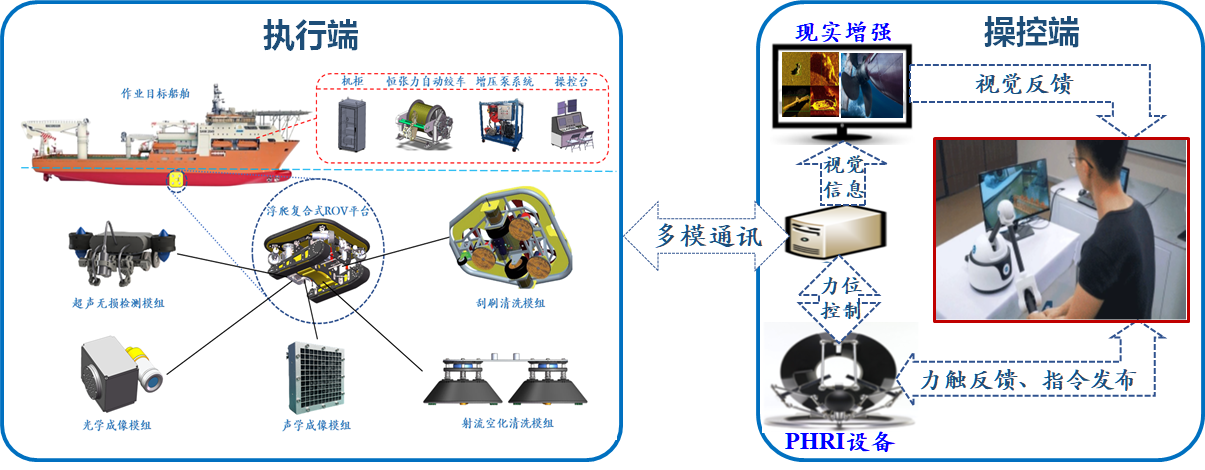
Solution Introduction Focusing on the operation and maintenance needs of large ships, relying on three core functions: intelligent inspection, online monitoring, and autonomous cleaning, we deeply integrate floating and climbing composite motion control technology, scraping and cavitation composite technology, sound and light multi-source imaging non-destructive testing technology, and human-machine collaborative control technology to achieve "human-machine collaboration, intelligent cleaning, and non-destructive testing".
Human-machine collaborationBy adopting control technology that combines floating and crawling movements, and integrating human-robot collaborative control strategies, a new mode of intelligent implementation for robots capable of both large-scale hull cleaning and non-destructive testing has been developed.
Intelligent CleaningThe rigid-flexible coupling cleaning technology for physical cleaning of underwater ship hull surfaces is adopted, integrating the technical advantages of scraping and cavitation cleaning to achieve high-performance scraping and cavitation composite cleaning operations on ship hull surfaces.
Non-destructive testingBased on underwater acoustic-optical multi-source heterogeneous imaging technology, non-destructive detection of internal and external defects in underwater ships is achieved through acoustic-optical multi-source imaging, enabling real-time acquisition of quantitative detection data.
Solution Value
Protect the safety of personnelRobots replace human labor in underwater operations, reducing the risks associated with personnel inspection and cleaning
Improve cleaning efficiencyThe robot can perform continuous cleaning operations for extended periods, with minimal impact from sea conditions, effectively shortening the cleaning cycle.
The results are standardized and reliableUtilizing a comprehensive approach of sound and light multi-source imaging non-destructive testing technology, it possesses the capability of integrating cleaning and testing, and automatically generates a comprehensive operation result report.
Reduce operation and maintenance costsIt can be cleaned at the anchorage without entering the port or dock, reducing ship downtime and effectively lowering ship cleaning costs.